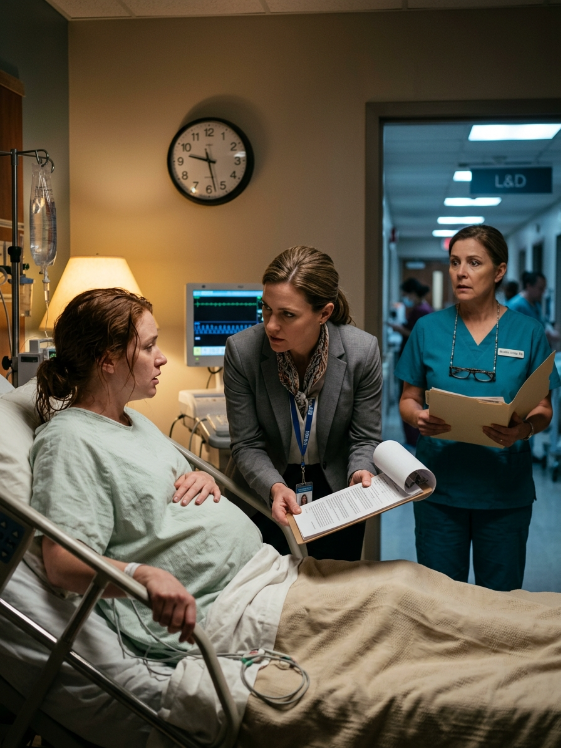
The social worker did not get her signature.
Renata set the manila file on the rolling table, gently, the way you set down something you have carried a long way.
“Six years ago I worked the women’s center over on Carnegie,” she said. “I was in the room when a teenager delivered a baby girl with a birthmark shaped like a little comma. Right here.” She touched her own shoulder. “Same shoulder your son has it on. Same comma.”
The monitor beeped. My whole body had gone cold and still.
“The mother’s name on this file is Cassidy Bloom,” Renata said. “Is that you, honey?”
“I went by Cassidy then,” I whispered. “Everybody called me Cassie after.”
Diane Pratt looked between us and started to say something about appropriate timing and the signing window.
“Step out,” Renata said, without heat. “Please. Now.”
For a moment Diane didn’t move. She had a packet, a deadline, and a tidy little assumption about what a woman like me would do with all three. Then she looked at Renata’s face, and she stepped out, and the door clicked shut on her clipboard.
Here is the thing nobody in that hospital knew. Six years ago I did not give my daughter away. Not the way that word is meant.
I was eighteen. Her father, a boy named Marcus Reyes I loved like weather, had shipped out to Fort Benning believing what my parents told him — that I had ended things, that I didn’t want a baby and didn’t want him.
None of it was true. My mother told it so smoothly that for a while I half believed I had agreed to something.
They drove me to the agency. They called it the kind thing. The mature thing. They said Marcus had already signed off, that he was relieved to be free of us both.
I signed because I was a child, and every adult in my life was pointing at the same door, and I did not yet understand that grown-ups could lie with their whole chests and still tuck you into bed at night.
I spent six years not even knowing her name.
Renata opened the file.
“I kept track,” she said. “Not officially. I’m not supposed to. But some of them you just can’t put down.” She turned a page. “She was placed with a family right here in Lakewood. Open adoption. The adoptive mother wrote letters. Every year. Photos. She left them at the agency for you.”
“I never got any letters,” I said.
Renata’s mouth tightened. “They were mailed to the address on file. Your parents’ house.”
The room tilted.
Every birthday. Every first day of school. A whole childhood of photographs, sent to a house where someone lifted them out of the box before I ever saw the mail.
“Her name is Lily,” Renata said softly. “She’s six. There’s a note in here from her mom, from this past spring. It says Lily has started asking about the lady who has her comma.”
I cried then — the way you cry when grief and hope land on the same nerve at the same time.
I would love to tell you the rest was simple. It wasn’t.
But the relinquishment packet for my son never got signed. I named him Theo, after no one, because he was going to be the first person in my life who belonged only to himself.
Renata sat with me through the rest of her shift, and then past it, off the clock, the way a stranger once sat with a frightened woman in a story I had read a long time ago. When the sun came up she made a phone call that I am fairly sure bent a rule or two.
The adoptive mother’s name is Grace. She called my hospital room two days later. Her voice shook as much as mine.
“Lily has always known your name,” she said. “We never hid you. We were waiting for the day the door opened from your side.” A pause. “We didn’t know it had been closed by someone else.”
I met my daughter on a Saturday, in a park in Lakewood, with Theo asleep against my chest. She walked up shy, then pointed at the place where his blanket had slipped off one small shoulder.
“He has my comma,” she said, like it was the most ordinary miracle in the world.
I confronted my mother exactly once. One phone call. She began to explain in that smooth voice, and I hung up before the first sentence finished. Some doors you close from your own side, on purpose, and you do not feel cold standing on the far end of them.
The hardest call came later, and I almost didn’t make it.
I found Marcus through an old friend. He was out of the Army now, living two states away. When I told him the truth — that I never ended it, that I never gave our daughter up by choice, that my family had told him one story and told me a different one — he was silent for a long time.
“They said you didn’t want me anywhere near you,” he finally said. “I believed it because believing it hurt less than fighting it.”
“I know,” I said. “They were good at that.”
He has met Lily once, with Grace there, careful and slow. He met Theo too. We are not a fairy tale. We are three grown adults and two small children learning, very carefully, what we are allowed to be to one another.
But the wall my family built with one smooth lie — the one that sent a good man to a base believing he was unwanted — finally came down, brick by brick, across a string of careful phone calls.
I have a son who is only mine, and a daughter who has two mothers who both finally showed up.
And a comma-shaped birthmark, on two small shoulders, finishing a sentence my family spent six years trying to erase.