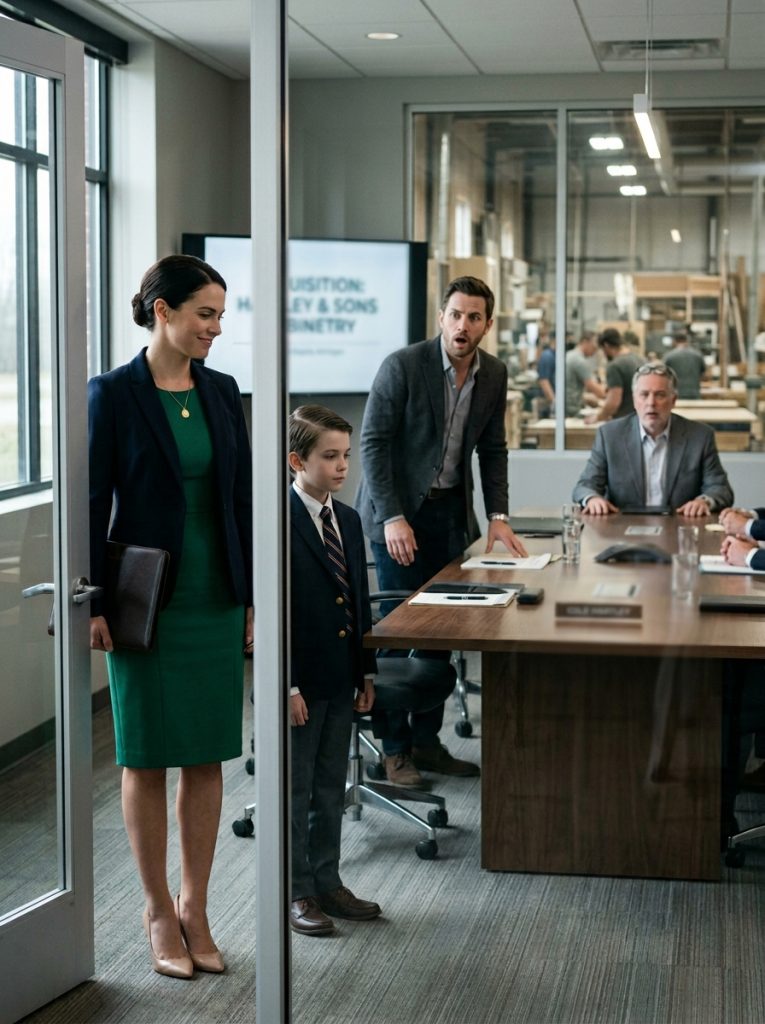
My father knew me before I finished the sentence.
I watched it land. The way his jaw came loose. The way his hand crept up off the table toward his chest, like the name Delia was a stone someone had thrown at him across ten years.
“You,” he said.
“Me,” I agreed, and I pulled out a chair and sat down at the head of the table he used to rule.
Eli took the seat beside me, folded his hands the way I taught him, and looked at the grandfather he’d never been allowed to meet with polite, unbothered curiosity. That composure undid Raymond more than any speech could have.
Cole found his voice first. He always did. “This is a conflict of interest. You can’t sit on this deal. You’re family.”
“Funny,” I said. “That word only seems to come up when it’s useful to you.”
I opened my folder. Not to be cruel. To be exact.
Hartley & Sons owed money to three banks and two suppliers and had missed payroll twice in the last quarter. I knew, because I’d bought the debt. Quietly. Over eighteen months. By the time my company appeared as the acquirer, Vantage already held every note that kept their doors open.
I could have closed those doors with a phone call. They knew it. The whole table knew it.
“Here’s what’s going to happen,” I said.
I slid the first page across. “Hartley & Sons stays open. Every person on the floor keeps their job, at a raise, because I’ve seen the wages you pay and they’re a disgrace. The brand survives. The town keeps its payroll.”
Cole blinked. He’d come ready for a war and I’d handed him a rescue.
I slid the second page.
“Raymond Hartley steps down as owner and chairman, effective today. He keeps his pension and his dignity and his name on the building, because the men who built this place with him deserve to keep seeing it. But he signs nothing, decides nothing, and votes on nothing. Ever again.”
My father’s eyes were shining. “Delia—”
“I’m not finished.”
Third page. I looked at my brother.
“Cole stays. As a floor manager. The job he’s never actually done. If he learns the business from the men he’s been underpaying, in two years we’ll talk about more. If he spends those two years complaining about fairness, he can find out how the rest of the world hires.”
The room was silent except for the hum of the shop floor through the glass — the sound of saws and sanders, of people who had no idea their futures had just been saved by a girl their bosses threw away at seventeen.
Raymond stood up slowly. For a second I thought he’d argue, posture, do the thing he always did.
Instead he came around the table and stopped in front of Eli.
“You have my father’s chin,” he said, voice cracking.
“Mom says I have your stubborn one,” Eli answered.
A sound came out of my father that I had never heard him make. He sat back down, put his face in his hands, and wept like a man who’d just done the math on everything he could have had at Sunday dinners for ten years and chosen, every single time, not to.
I didn’t comfort him. Some debts you have to feel the full weight of.
But I didn’t gloat either. That’s the part the people who knew the old story always expect — the speech, the slammed door, the revenge.
Revenge would have meant I still needed something from them. I didn’t. I’d built a life so complete that the worst thing I could do to the people who exiled me was simply let them watch it.
We renamed the flagship cabinet line that spring. The Elias, after the grandfather who would have loved my son without conditions. It outsold everything they’d made in a decade.
My father comes to dinner now. Once a month, on my invitation, on my terms. He’s quieter than he used to be. He reads to Eli. He’s earning something that can’t be bought back, only built, slow, the way I had to build everything.
Last week Eli asked me if I was still angry at them.
I thought about the porch in the rain. The four months. The ten years of silence.
Then I looked around the kitchen I paid for, at the boy they told me to give up doing his homework at my table.
“No, baby,” I told him. “I’m not angry. I won.”