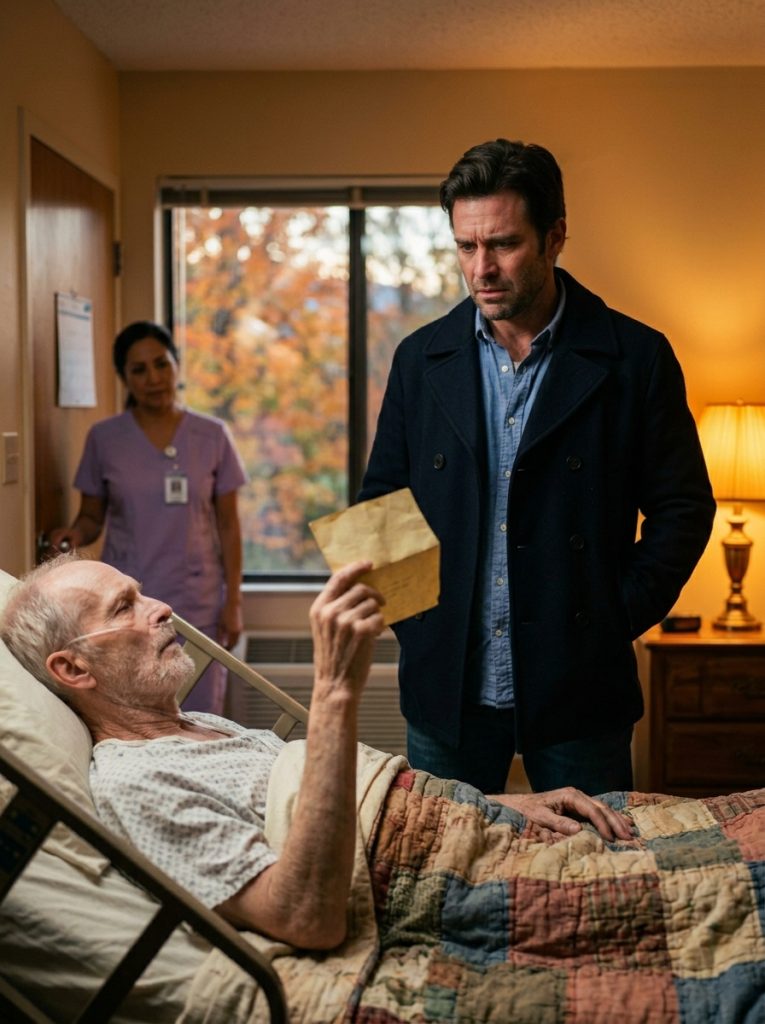
I sat down. I don’t know exactly when. One moment I was standing with my coat on, and the next I was in the chair by the bed, and the nurse had quietly stepped out, and it was just the two of us and the sound of the oxygen.
I didn’t open the envelope yet. I asked him to tell me himself, while he still could.
So he did, in pieces, resting between sentences.
When I was eight, my father’s small contracting business went under. He owed money to the wrong people and to the right people both, and he was drowning. My mother’s father — my grandfather, a man I’d been raised to revere — offered a way out.
He would cover the debts. He would keep us in the house. He would make sure I never went without.
On one condition. Walter had to go. Quietly. Permanently. No fight, no explanation, no custody battle that would “drag the family name through the mud.”
“He told me a judge would side with money over a man with debts and a failing business,” my father said. “And he wasn’t wrong, back then, in that town. I believed I’d lose you and ruin you both in the process.” He closed his eyes. “I took the deal. It’s the worst thing I ever did. I told myself I was protecting you.”
“You let me think you didn’t want us,” I said.
“That was part of the deal too,” he whispered. “Your grandfather said a clean break was kinder than a slow one. That if you hated me, you’d stop waiting by the window.” His voice broke. “I agreed to be the villain. I thought it was the last useful thing I could do for you.”
I wanted to be angry. I was angry. But it’s hard to hold a clean, righteous anger over a man who’s apologizing with what’s left of his breath.
“You never paid a dime,” I said. “Mom said—”
“Open it,” he said. “Now you can open it.”
So I did.
It wasn’t a letter, not really. It was a record. Decades of it.
Cancelled checks. Money orders. A faded ledger in his blocky handwriting. Every month, for years, a payment sent to an account in my grandfather’s name “for Eli.” Tuition for the school I’d thought I got into on scholarship. The down payment, I realized with a lurch, on my first car, which my mother had told me came from her.
Money sent faithfully by the man I’d been told sent nothing.
Intercepted, every time, by the people who’d sent him away.
“I couldn’t see you,” he said. “It was the one thing I could still do. So I did it. Every month. I never knew if any of it reached you.”
It had reached me. It had built half my life. I’d just been told a different name for where it came from.
I stayed the night. I’m glad I did, because there wasn’t another one.
We didn’t have a grand reconciliation. He was too tired and I was too overwhelmed, and the movies lie about how much can fit into a few hours. But I held his hand, and I told him I read it, all of it, and that I understood now, and that I wasn’t going to spend whatever came next hating a ghost.
He smiled at that. He drifted. Near dawn, he was gone.
The aunts and cousins who’d called me cold came to the funeral in their grief like it was a costume. I let them. I’d stopped needing their version of me to be wrong out loud.
But I drove to my mother’s house after, with the envelope on the passenger seat.
She knew the moment she saw it. I watched it move across her face — recognition, then fear, then the old practiced defense.
“You don’t understand the position we were in,” she started.
“I understand he sent money for twenty years,” I said, “and you told me he sent nothing. I understand Grandpa bought a man’s silence and you spent it. I understand that the villain in my whole childhood was the only one of you telling me the truth, and he wasn’t even allowed to.”
She didn’t deny it. That was its own kind of answer.
I’m not at peace with my mother. I don’t know if I will be. That’s the part the deathbed didn’t fix — it just moved the wound to a new place. I went there to ask my father one question, why did you leave, and I left with a heavier one I’ll be carrying a long time: how do you forgive the parent who stayed, when staying was the lie?
I keep the ledger in my desk. Not to nurse the anger. To remember that the story everyone agrees on is not always the true one, and that the quietest person in the room is sometimes the one who paid the most.
My father was the villain of my life for twenty-eight years.
He was the only one who never lied to me.
I wish I’d opened that envelope twenty years sooner. I wish he’d had the chance to be more than a letter under a pillow.
But I read his name in his own hand on every page, and I finally know it was love.
Late. Intercepted. But love.