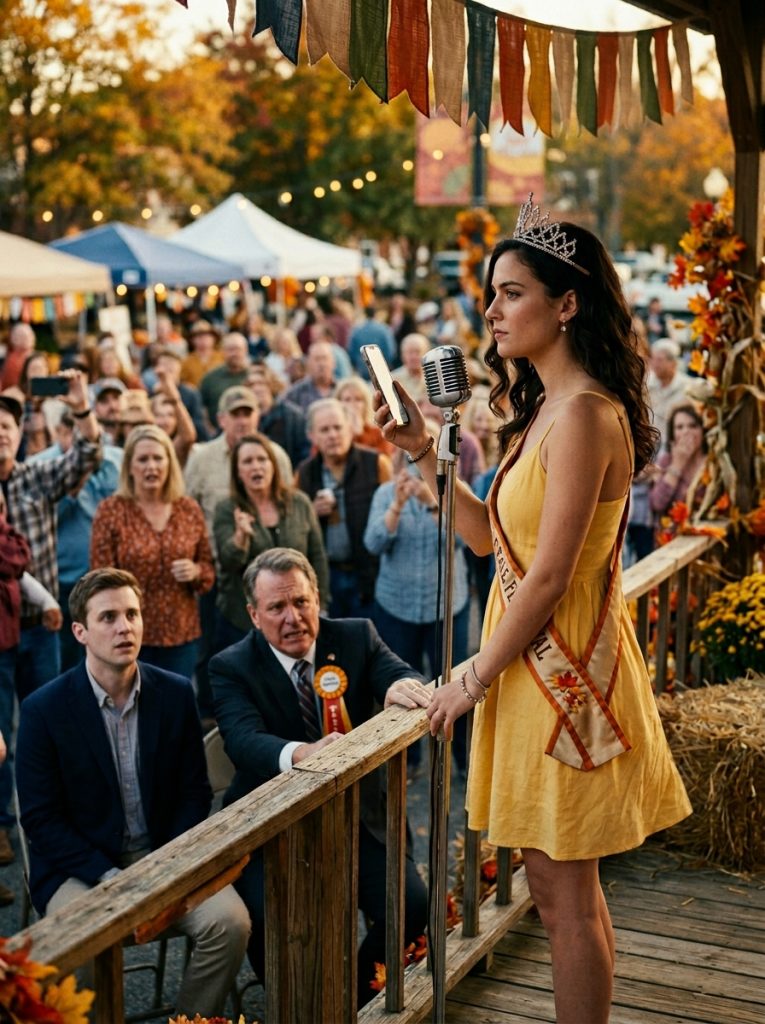
The first voice out of my phone was Preston’s.
I’d turned the volume all the way up and held it to the microphone, and his voice rolled out across that town square, over the hay bales and the banner and four thousand people who thought they already knew the truth.
It was a voicemail. From fourteen months ago. Before any of it started.
“Sav, it’s me. I know I said I’d tell people I’m separated — I am, basically, it’s just paperwork. Don’t listen to whatever my mother says. I want this. I want you.”
A murmur went through the crowd. I let it build, then I cut to the next one.
His mother. Eleanor Caldwell. A recording I’d made the day she came to my mother’s kitchen with a check and an ultimatum, because some part of me, even then, knew no one would ever believe a waitress over the mayor’s family unless she had it in their own words.
“We’ll give you twenty thousand dollars to leave Marigold and keep your mouth shut,” her voice said, crisp as a Sunday dress. “You’ll say you made it up. You’ll say you chased him. Preston has a future in this town and you are not going to be the thing that ends it. If you stay and keep telling this story, we will make sure no one in this county believes a single word you say.”
The square went very, very quiet.
Because they had believed it. Every word the Caldwells told them to. For a year.
I lowered the phone. My hand was steady now. Funny how that works — you shake for a year and then, at the exact moment you need it, you go still as glass.
“I didn’t chase a married man,” I said into the mic. “I was told he was getting divorced. By him. When I found out the truth, I ended it. And for that, this family decided it was cheaper to burn my name than to tell their own.”
I looked at Preston in the front row. He’d gone gray.
“They told you I was a liar,” I said to the crowd. “They were half right. There was a lie. It just wasn’t mine.”
And then I said the last thing, the thing I’d been carrying alone, the reason Eleanor Caldwell wanted me gone so badly she’d put a number on it.
“I’m four months along,” I said, and my voice only cracked on the last word. “I wasn’t going to say it like this. I wasn’t going to say it at all. But I am done letting people who lied about me decide what my child gets to grow up believing about its mother.”
I watched it move through the crowd like wind through a field — the slow, sick understanding of people realizing they’d been the weapon. The woman who’d yelled to take the crown off me had her hand over her mouth. The hairdresser who’d told the whole salon I was trash. The men who’d gone quiet whenever I walked into the hardware store. I’d felt every one of those small cuts for a year. Now I watched them feel it back.
Mayor Caldwell came up the stage steps then — to “restore order,” the way he always does. He reached for the microphone.
A voice stopped him.
Pastor Mary Odell, who has known me since I was in the nursery, stood up in the third row. “Leave the girl be, Glenn,” she said. “We’ve all got some apologizing to do, and you most of all.”
She wasn’t the only one standing now. Half the square was on its feet. Not against me this time.
The town that convicted me in a year acquitted me in about ninety seconds, which tells you everything about how thin the case had been to begin with.
The fallout was real. The local paper, the one that had run the gossip as good as fact, printed the recordings and a front-page correction with my name spelled right for once. Preston’s wife filed for divorce on her own terms, with her own lawyer, and good for her. The mayor announced he “would not seek reelection to focus on his family,” which is how men like that say the word lost.
Eleanor Caldwell never apologized. Some people can’t. But she moved to her sister’s place in Savannah by Christmas, and I can’t say the air in Marigold got any worse for it.
The apologies that did come were the quiet kind. A casserole on my porch with a note that just said sorry, no name. The hardware store man waving me to the front of the line. My old boss at the diner offering me my pick of shifts and a raise I hadn’t asked for. None of it gave me back the year. But it added up to a town slowly remembering how to look me in the eye.
Me? I kept the crown, actually. The festival committee voted, unanimously this time, that it stayed mine. I thought about throwing it in a drawer. Instead I keep it on a shelf where my daughter can see it when she’s old enough to ask.
And when she asks, I’ll tell her the truth. All of it.
That her mama got booed by a whole town once.
And then she pressed play.