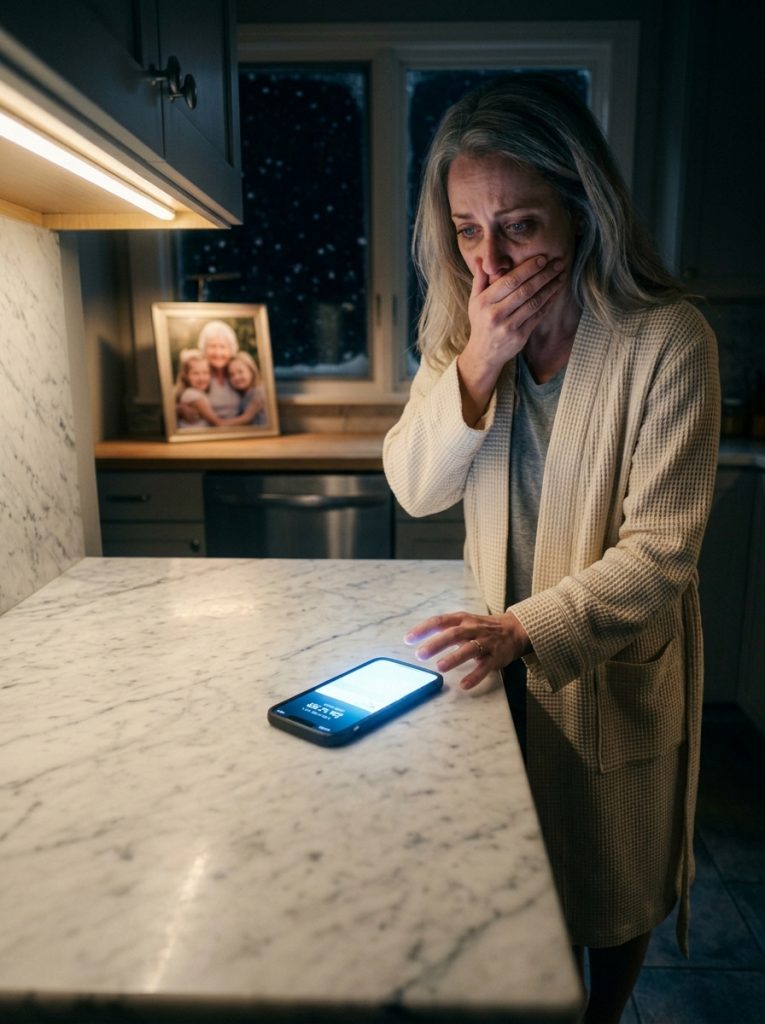
The screen lit up in the dark with a name I had buried eleven years ago.
Carol.
I stood at the kitchen island in my robe, bare feet on the cold tile, and watched my sister’s name glow against the black window where the snow was ghosting the glass. 12:02 a.m. On the sill, our mother’s photo watched me — Mom holding both of us as little girls, before any of this.
I almost didn’t answer. Eleven years of silence builds a wall you forget how to climb.
But my thumb moved on its own.
I didn’t say hello. I just listened. For a long moment there was only my sister breathing, ragged, like she’d been crying for hours.
Then Carol said three words.
“It wasn’t you.”
And the wall I’d built for eleven years cracked straight down the middle.
Let me tell you what those three words undid.
Our mother, Eileen, died of ovarian cancer in a hospice bed in Denver eleven years ago. In the weeks before, she asked me to handle her accounts — I lived ten minutes away; Carol lived three states off. I had power of attorney. I paid the bills, I sat the nights, I held the cup to her lips.
And one afternoon, Mom gripped my wrist with what strength she had left and told me a secret that would cost me my sister.
“Nathan is using again,” she whispered.
Nathan. Carol’s son. My nephew. Nineteen then, and drowning. Heroin. Carol couldn’t see it — wouldn’t — because the seeing would have broken her, and because admitting it felt to her like admitting she’d failed as a mother. So she called it a phase. A rough patch.
Mom didn’t call it a phase. Mom called a private clinic in Arizona that cost more than most people make in a year, and she emptied her savings — every account, down to the last certificate — to pay for ninety days that might save the only grandson she had.
“Carol’s pride will kill that boy before the drugs do,” Mom told me. “She’ll refuse the money. She’ll say we’re calling him an addict. So she can’t know. Swear to me, Megan. She can be angry at you. She cannot know where it went. Not until she’s ready. Promise me.”
I promised a dying woman.
Three weeks later we buried her, and in the funeral home parking lot, in the rain, Carol found the accounts empty and turned on me.
“You took everything,” she screamed, finger in my chest. “You were the only one with access. You robbed her while she was dying.”
I had a choice in that parking lot. I could break my promise and tell my sister her son was an addict on the worst day of her life — or I could let her believe I was a thief.
I let her believe it.
She told the cousins. The church. She blocked my number, returned my cards unopened, raised her kids in photographs I saw secondhand. I let all of it land, because somewhere in Arizona a boy was getting clean on money no one could ever know about, and a promise is a promise even when it’s eating you alive.
I never told. Not in eleven years.
So how did Carol finally know?
“Nathan told me,” she said on the phone, her voice shaking. “Tonight. He’s ten years sober, Megan. Ten years. He stood up at his meeting with his chip and then he came home and he sat me down and he told me everything. That Grandma paid for Sedona. That you handled it. That you swore to keep it secret because Mom thought I’d be too proud to let you save my son.”
I gripped the counter so I wouldn’t go down.
“He said you’ve sent him a card every year on his sober anniversary,” she went on. “Anonymous. No name. Just — ‘Proud of you. Keep going.’ Ten cards. He kept them all. He recognized your handwriting tonight.” She made a sound that was half a laugh and half a sob. “Eleven years I let people call you a thief. Eleven years, and you let me. Why would you let me?”
“Because Mom asked me to,” I said. “And because if it kept Nathan alive, I could carry being hated. I couldn’t carry losing him.”
My sister cried then, the way you cry when shame and relief hit at the same time. I cried too, alone in my dark kitchen with our mother’s photo glowing on the sill.
“There’s a letter,” I told her finally. “Mom wrote it before she passed. Gave it to her lawyer with instructions — give it to Carol ‘when she’s ready, and not one day before.’ I think today’s the day. Call him in the morning.”
She read it to me two days later, sitting in my kitchen, both of us puffy-eyed over coffee. Mom’s handwriting. I won’t give you all of it. But the last line I’ll carry to my own grave: “Be gentle with your sister, Carol. She kept my hardest secret so you could keep your son. There was never a thief in this family. Only love that didn’t know how to explain itself in time.”
Carol is here for Christmas this year. First time in eleven years.
Nathan drove her. He hugged me at the door for a long, long time.
We lost eleven years to a promise and a lie that was really a kind of love. I’d be lying if I said I don’t grieve them.
But my sister called me at midnight and said it wasn’t me.
And after eleven years of silence, three words were enough to start again.