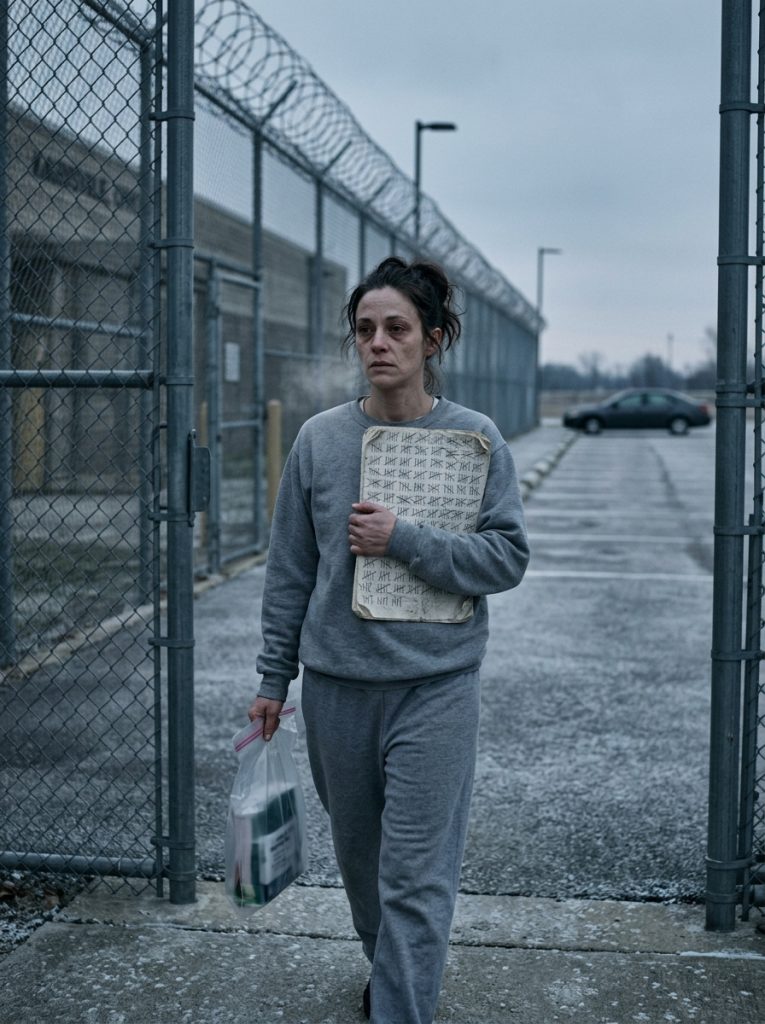
What I built in 2,555 days was a case.
The first year inside, I stopped crying and started reading. The prison law library became the only place that felt like oxygen. I read trial transcripts until I understood what my overworked public defender never had time to chase.
The foundation money hadn’t vanished into thin air. Money never does. It moves. And the forged signature that sent me away — the one that “looked just close enough” — had a tell. A little hook on the capital H that I never made and Paige always did.
I couldn’t prove it from a cell. But I could organize it. I filled three notebooks. Account numbers I remembered. Dates. The name of the bank officer who’d processed transfers while I was supposedly in two places at once.
In year three, a legal-aid clinic started visiting the facility. A young attorney named Devon actually listened. He took my notebooks out in a manila envelope and promised nothing, which is how I knew he was honest.
It took four more years. Four years of him pulling records I couldn’t reach, of a forensic document examiner confirming the hook on the H, of subpoenaed bank statements that traced the foundation’s “missing” money straight into renovations on my own house — the house Paige was living in.
The proof was finished six weeks before my sentence ended anyway. The system is slow even when it’s saving you.
So I walked out that gray morning not as a woman hoping for justice someday, but as a woman whose exoneration was already filed, already moving, already true. The empty parking lot didn’t scare me. I’d stopped waiting for anyone a long time ago.
Three months after my release, my conviction was vacated. A judge said the words “actual innocence” into a record that had called me a thief for seven years. The state issued a letter. Devon framed his copy.
And then the part everyone wants to hear about, the part that’s supposed to feel like winning.
Paige was charged. Embezzlement, forgery, perjury. The pretty tears she cried at my trial became evidence against her at her own. The house was seized as proceeds. The camel coat and the designer sunglasses didn’t survive the discovery process.
I’d be lying if I said there wasn’t a cold, clean second where it felt like the universe finally balanced.
But here is what no transcript and no settlement could give me back.
Lily was five when they took me. She is twelve now. For seven years, the woman who framed me tucked my daughter in at night. Lily learned to read, lost her first tooth, learned to ride a bike, all of it, calling Paige “Mom.”
When I finally stood in front of my own child, exonerated and free, she looked at me like a stranger. Because to her, I was one.
I had imagined that reunion 2,555 times. In every version she ran to me.
In real life she stepped behind a social worker and asked, very quietly, when she could go home.
That’s the thing the calendar couldn’t measure. They give you back your name. They give you back your record, even some of your money. Nobody can give you back the seven years of a little girl’s life that someone else got to keep.
So I didn’t grab her. I didn’t tear her world apart to make mine whole. That would have been for me, not her.
I went slow. Supervised visits first. A park. Ice cream. Letting her set the pace. I learned her favorite color had changed twice since I’d memorized it. I learned to love the stranger she’d become instead of mourning the five-year-old who was gone.
It’s been a year now. Last week she called me “Mom” without thinking, then froze, scared she’d hurt someone by saying it. I told her there was no wrong way to do this. We’re inventing it as we go.
I never burned the calendar.
I thought I would. I pictured it a hundred times — striking the match, watching 2,555 days curl into ash.
Instead I framed it. It hangs in my hallway, all those pencil marks behind glass.
Not as a monument to what was stolen.
As proof that I counted every single day on my way back to her — and that I never once stopped believing there’d be a day worth marking on the other side of the wall.