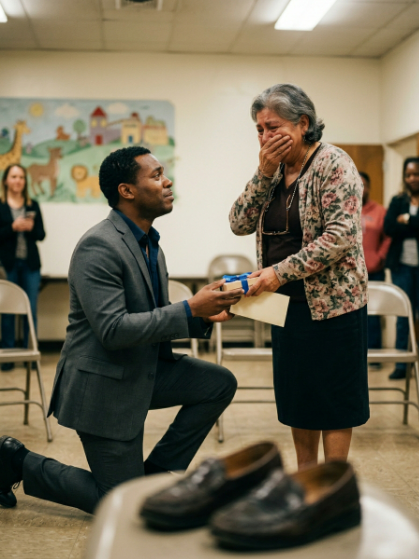
“Andre?” she whispered, through her fingers. “Little Andre Coleman?”
“Not so little anymore,” I said, and my voice cracked on it.
I helped her into a folding chair before her knees decided for her. The community center was the same one where she used to meet me on visit days, twenty years ago, with a juice box and a folder full of my whole complicated life.
I’d told the staff I was hosting a small retirement gathering for a beloved former caseworker. That part was true. What I hadn’t told her was who was coming.
Because it wasn’t only me.
There was Marcus, who runs a body shop in Akron now. There was Tanya, a nurse, who used to hide under tables. There was Devon, who almost didn’t make it out at all, holding his own daughter on his hip. Eight of us. Eight kids Ruth Delgado carried through the worst years of our lives, grown up and standing in a half-circle around her chair.
She looked at all of us and started to cry.
“I used to lie awake,” she said. “Thinking about the ones I couldn’t help. The ones who fell through. I never let myself count the others. It felt like bragging on something that was just my job.”
“It was never just your job,” I said.
I knelt down in front of her, the way she used to kneel down in front of me so we’d be eye to eye.
“You want to know what I remember most?” I said. “Not a placement. Not a court date. I remember the space documentary you brought on a little portable player when I was ten, because I told you once I wanted to see Saturn. We watched it in a McDonald’s parking lot because my foster house didn’t want me touching their TV. You missed your dinner. You never said so.”
Ruth pressed her hand harder over her mouth.
“I run a company now,” I said. “Forty people. When I interview someone, I ask myself one question: would this person watch a documentary in a parking lot for a kid who isn’t theirs? I learned that from you. Every good thing I know about showing up, I learned from a woman in taped-together shoes.”
I handed her the small wrapped box first.
She opened it with shaking hands. Inside was a pair of good leather shoes. Soft. Warm-lined. The kind that don’t crack across the toe.
“I noticed your shoes when I was nine,” I told her. “Same brown loafers, every visit. Taped together once. I asked you why you never bought new ones and you changed the subject.”
She laughed wetly. “You remembered that.”
“I found out why, years later. You were buying our coats. Our cleats. Our birthday cakes. You wore broken shoes so we wouldn’t have to.” I put the envelope in her hands. “So I’ve been waiting a long time to do this.”
She opened the envelope.
The first page was the deed to her house. Paid in full. The mortgage she’d been carrying into her retirement on a social worker’s pension — gone.
The second page was the part I was proudest of.
I’d started a fund. The Ruth Delgado Fund, for kids aging out of foster care with nowhere to land. Emergency rent. Bus passes. Winter coats. Cleats. The exact small mercies she’d paid for out of her own thin paycheck, now multiplied, now permanent, now wearing her name.
“You spent your whole life giving us what nobody made you give,” I said. “Let us give some back.”
For a long moment she couldn’t speak at all.
“I was so afraid it didn’t matter,” she finally said. “You go home every night and you don’t get to see how the story ends. You just hope.”
“It mattered,” Devon said from behind me, his voice rough. The others said it too, one after another, until the little room was full of it.
Tanya stepped forward. “You sat outside my hospital room for two days when I was sixteen,” she said. “The state didn’t pay you for that. You did it anyway. I’m a nurse now. I sit with scared kids because somebody once sat with me.”
Marcus just put his hand on Ruth’s shoulder and couldn’t get a word out at all.
I won’t pretend it was all triumph. There’s a bittersweet in it I’m still learning to hold.
There were names that should have been in that circle and weren’t. Ruth knows every one. So do I. The system that broke us was bigger than one woman with taped-up shoes, and no envelope of mine could buy back the years any of us spent being shuffled from house to house.
But that night, in that room, a woman who gave everything and assumed it disappeared got to see exactly where it went.
She wore the new shoes home.
The old brown loafers, she told me later, she keeps on a shelf by her door.
To remember, she said, that the smallest things you do for a child can walk around in the world for twenty years and come back wearing a suit.