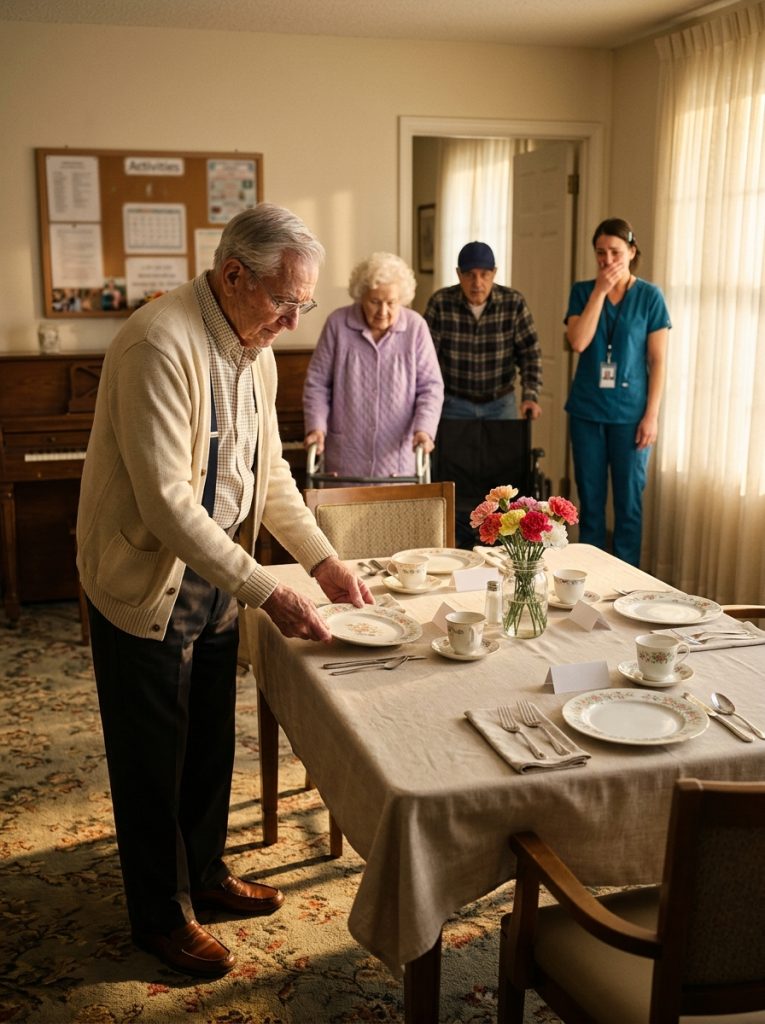
Five plates. Real china, the kind with a gold rim worn thin from washing. Mr. Pruitt set them every Sunday at 5 p.m. at the long table in the common room, and one chair at the head always stayed empty.
I’m Dana. I started as the activities aide at Cedar Grove last March. My first week, my supervisor nodded at the old man unwrapping dishes from a bath towel and said, “That’s Arthur. Sundays are his. Just let him have it.”
So I let him have it. Every Sunday, Arthur — 84, pressed cardigan, suspenders, hands that tremble now — smoothed the white cloth, set out five mismatched plates around a jar of carnations he bought himself at the grocery, and laid the head of the table for a guest who never came.
He has three children. I found their numbers in his file, and one slow Sunday when my heart got the better of my judgment, I called them. The eldest had “such a busy season.” The middle one said, “He’s where he needs to be,” in the voice people use to end a conversation. The youngest never called back.
I decided it was just loneliness. A sweet, sad old man setting a table for ghosts. I’d seen it before. You learn not to look too long.
Then one Sunday he asked me to fetch his good napkins. Top drawer of his dresser.
The napkins were there. So was a shoebox.
I shouldn’t have opened it. I opened it.
Inside was thirty years of paper. Tuition checks — three names, three universities, every one marked PAID. A second mortgage on a house I didn’t recognize. The deed to a colonial in Raleigh, signed over to “my son, with all my love, Dad.” And on the bottom, the sale papers for Arthur’s own home. Sold when he was 71. Below market. A handwritten note clipped to it in his shaking hand: “So the children never have to carry me.”
He didn’t lose his family to neglect. He spent himself down to nothing building theirs. The down payments. The weddings. The emergency that was always somebody’s emergency. He gave them the house, the savings, the steady hand under every step they ever took — and then he moved himself into a single room and set a table for them every week, waiting to be remembered by people who had already taken everything he had to give.
I put the box back exactly how I found it. Then I went into the supply closet and cried into a stack of folded bingo cards.
Here’s the part I didn’t expect.
That same Sunday, I came back out with my eyes still red, and I watched Sal — 78, wheelchair, ballcap, the grumpiest man on the floor — roll himself up to Arthur’s table and park at one of the empty places.
“This seat taken, Pruitt?”
Arthur blinked. “It’s — well. I usually save it.”
“Save the head one,” Sal said. “I’ll take the side.”
Then Lottie Mae came shuffling over with her walker, white curls and a lavender housecoat, and sat down across from him without asking. Then Mr. Ferris. Then the Acosta sisters. By 5:15 every one of Arthur’s five plates had a person behind it, and they were arguing about whether the carnations needed more water, and Arthur Pruitt was laughing — really laughing — for the first time I’d ever seen.
I went to my supervisor the next morning. I told her everything. I asked if we could make it official.
So now, every Sunday, the kitchen sends up a real dinner. Pot roast, the good rolls. The staff who can stay, stay. We pulled two more tables together because the first one stopped being big enough. Arthur sits at the head, and he sets that last empty place every single week, because he says, “You never know who might finally come.”
And in November, someone did.
His youngest daughter — the one who never called back — walked into the common room on a Sunday at 5:10, coat still on, eyes already wet. I don’t know what changed. Maybe a phone call. Maybe just the weight of a year. She stopped in the doorway when she saw it: her father at the head of a crowded, noisy, laughing table, completely surrounded.
He saw her. The room went quiet.
For a long moment nobody breathed. Then Arthur stood up, slow, with both shaking hands on the table, and he gestured to the one chair he always keeps empty.
“I saved you a seat,” he said. Not cold. Not cruel. Just true. “I always saved you a seat.”
She sat down and put her face in her hands and he reached over and patted her shoulder the way you pat someone you forgave a long time ago, because waiting that long does something to a person — it either makes them hard, or it makes them kind, and Arthur chose kind every Sunday for years when no one was watching.
I still tear up setting that table. I’ve stopped pretending I don’t.
He set a place for a family that never came. And in the end he got one anyway — just bigger, and louder, and held together by people the world also forgot.
We’re his family now. And nobody at Cedar Grove eats Sunday dinner alone.