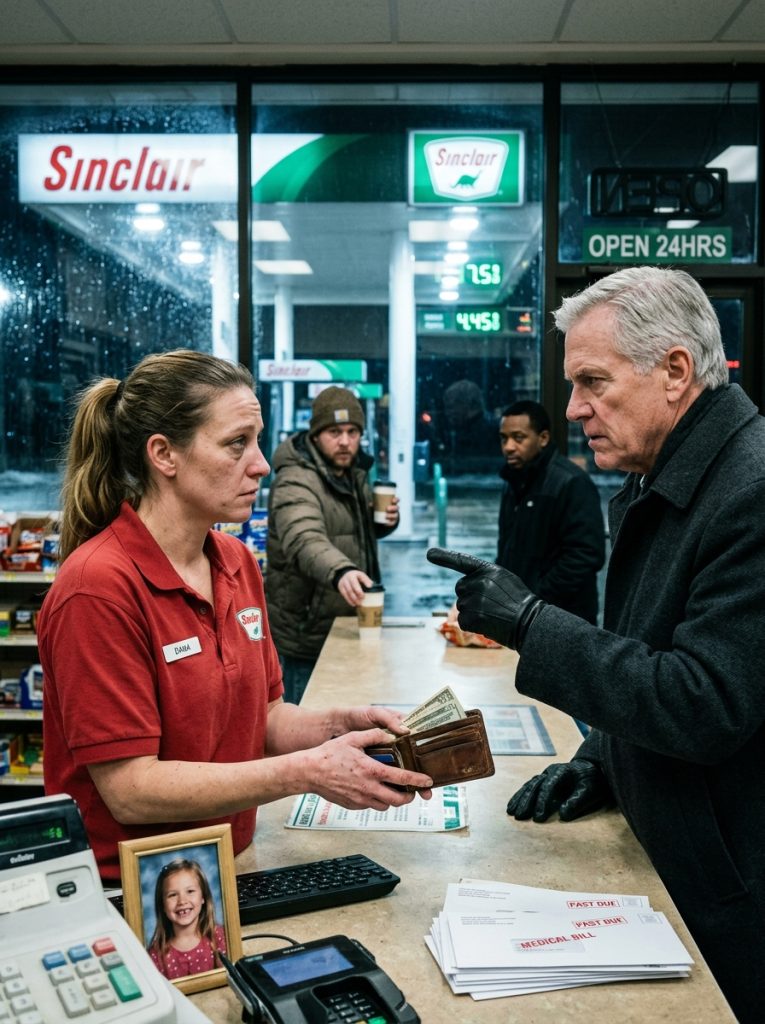
I didn’t answer him right away.
You don’t hand a stranger your daughter’s medical history across a gas station counter at two in the morning. Especially not the stranger who just called you a thief in front of the whole store.
But he wasn’t looking at me like a thief anymore.
“Leukemia,” I said finally. “She’s in remission now. The bills aren’t.”
Calvin Mercer — that was the name on the cards inside, the name I hadn’t let myself stare at too long — laid both gloved hands flat on my counter.
“I owe you an apology,” he said. “And then I owe you the truth. The apology comes first. I’m sorry. That was a cruel thing to do, and I knew it was cruel while I was doing it.”
“Then why do it?”
“Because I needed to be sure.”
He told me he’d been leaving that wallet on gas pumps and diner counters for almost twenty years. Not as a trap. As a question.
He runs a freight company. Mercer Freight — four hundred trucks, terminals in nine states. He said the higher he climbed, the fewer honest people he could find standing next to him.
“Everybody’s honest when they’re being watched,” he said. “I stopped believing in that kind of honest a long time ago. So I started watching what people do when they’re sure no one is.”
Most people kept it, he said. Took the cash, dropped the cards in a mailbox. A few turned it in to the police — minus a bill or two, for their trouble.
“You ran into the sleet,” he said. “In a polo shirt. To catch a man who was already gone.”
“I didn’t do it to be seen.”
“I know.” He almost smiled. “That’s the entire point.”
Then he picked up the stack of red envelopes by my register. He didn’t ask. He just lifted them, read the top one, and went very still.
The trucker by the coffee machine had stopped pretending not to listen. So had the woman with the cigarettes — the one who’d backed away from me like decency was something contagious.
Mercer turned to them.
“You two were awful quick to watch her hang,” he said quietly. “Neither one of you said a word.”
The woman mumbled something about not wanting to get involved. Mercer just looked at her until she found the door.
Then he turned back to me, and his voice changed. It went level. Almost gentle.
“How much,” he said. “All of it. The number you don’t say out loud.”
I told him. It’s a number I know the way you know an old wound. Forty-one thousand, two hundred and sixteen dollars.
He didn’t flinch.
He took a checkbook out of the same wallet I’d just handed back to him.
“Mr. Mercer,” I said, “I can’t take—”
“You’re not taking anything. You already gave.” He kept writing. “I’m a man who tests strangers with cash because otherwise I can’t sleep. You think I don’t know what that makes me? You handed back the answer to a question I’ve been asking for twenty years, and you didn’t even know you were being asked. Let me do the one clean thing I get to do this year.”
He slid the check across the counter, face down — the same way I’d slid the wallet to him an hour before.
“Count it later,” he said. “Slower.”
I did look. Of course I looked.
It was the whole number. And under the memo line, in small block letters, he had written: FOR MIA.
But that wasn’t the part that took my legs out from under me.
Before he left, he set a second card on the counter. A real one this time, his own, warm from his pocket.
“My dispatch center here in Salina runs around the clock,” he said. “It is staffed by people who couldn’t find their own honesty with both hands and a map. You’ve got a phone voice, a backbone, and you do arithmetic under fire. Call that number Monday. Day shift. Benefits start day one.” He paused. “A seven-year-old shouldn’t have to fall asleep wondering if her mother’s still standing behind a register at two a.m.”
Then Calvin Mercer pulled his gloves back on, picked up the wallet that started all of it, and walked out into the sleet.
The trucker bought his coffee without meeting my eyes.
I stood alone under the fluorescent lights with a check face down on the counter and a card beside it, and I thought about every night I’d added those numbers up and come out short.
I called the number Monday morning.
I started days the following week. I’m home now before Mia wakes up. She thinks the new lunchbox is the miracle. I let her think that.
Every payment I make now, I make on time — to a hospital that no longer prints my daughter’s name in red.
People ask me, when I tell this story, how he knew to pick our station. That pump. That night.
He didn’t pick it.
He dropped a wallet, the way he always does, and waited to see who I’d be when I was certain no one important was watching.
It turned out the most important person in the world was standing right in front of me the whole time.