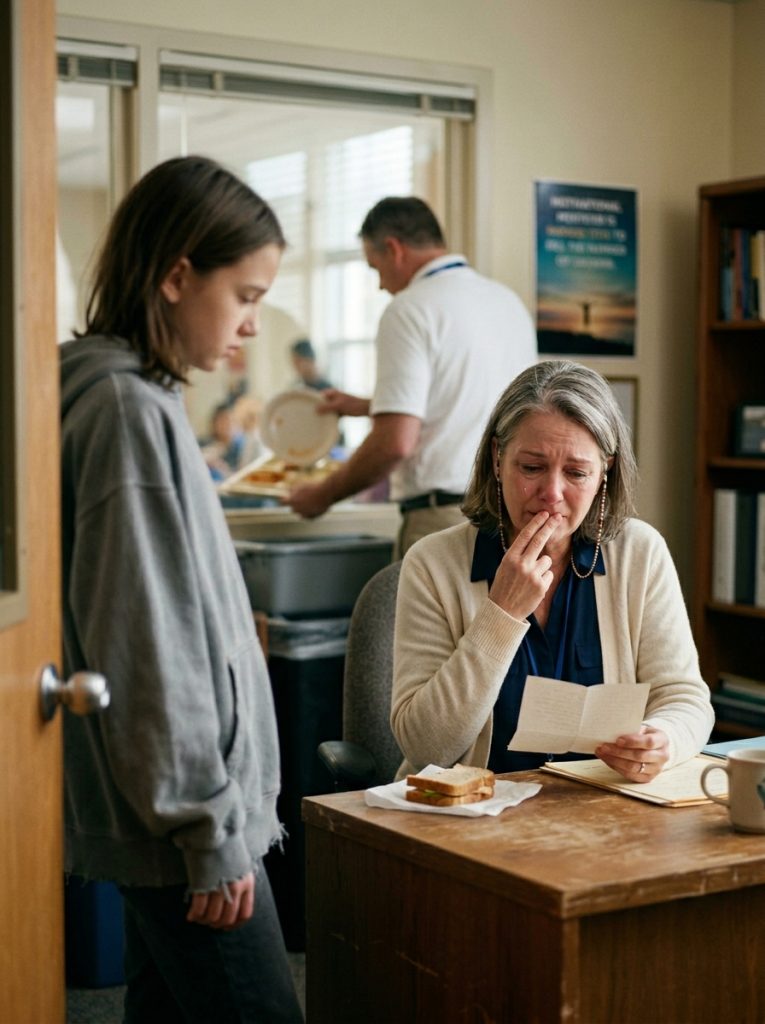
I told her the truth, because once somebody finally looks at you, the lying gets too heavy to hold.
“Since my mom’s hours got cut,” I said. “A few months. It’s not her fault.”
Ms. Bellamy didn’t gasp. She didn’t make a big thing of it, which is the only reason I stayed.
She just nodded, slow, like I’d handed her something fragile and she was deciding where to set it down.
“Thank you for trusting me with this, Lily,” she said. “You did a brave thing. Braver than most grown-ups manage.”
Then she asked if I’d had breakfast. I shook my head.
She opened her own desk drawer and put a granola bar and an apple in front of me like it was the most ordinary thing in the world, and she talked about other stuff while I ate so I wouldn’t feel watched.
I thought that was the end of it. A kind lady. A snack. Back to math.
I was wrong about almost everything.
Starting with who Ms. Bellamy actually was.
The next morning there was a black car in the visitor lot and a buzz in the hallways. Teachers stood up straighter. The principal, Mr. Dawes, kept fixing his tie.
Because the “temporary counselor” nobody took seriously had a different name on a different door across the district.
Grace Bellamy was the county’s incoming superintendent.
She hadn’t been filling in to pass the time. She’d been doing what she always did before she ran a district — she’d planted herself, quietly, in the smallest office in the building, and watched how a school treated the kids who had the least.
For three weeks she’d been invisible on purpose. Same as me.
And she’d seen plenty.
She’d seen the lunch line.
Because here is the thing I hadn’t put words to yet. The reason I rationed sandwiches in a building that threw food away.
His name was Mr. Stahl. He ran the cafeteria.
When a kid’s lunch account hit zero, Mr. Stahl didn’t quietly hand them a tray. He called the number out. Loud. “Navarro, you’re at zero again.” He’d take the hot tray back and slide over a cold cheese sandwich so everyone knew which kids were the poor ones.
And the food the other kids didn’t finish — whole trays, untouched fruit, sealed milk — he scraped straight into the trash. “Policy,” he said. “Can’t give away food.”
Dozens of us were hungry six feet from a garbage can full of lunch.
Ms. Bellamy saw all of it. She’d written it down. My note just put a face on a thing she’d already decided to end.
She moved fast.
By Thursday there was a new room next to the gym. No sign on the door, on purpose — she didn’t want it to be a place kids got teased for using. Inside: shelves of food, snack packs, granola bars, fresh fruit, a little fridge with milk and sandwiches.
Any kid could walk in. No names. No accounts. No line. You took what you needed and you left, and nobody at the door so much as raised an eyebrow.
She called it the quiet pantry.
The food that used to go in the trash went on those shelves instead. She got the rule changed the same week — donated and unserved food now went to students first, in writing, district-wide.
Then she dealt with Mr. Stahl.
I didn’t see it, but the lunch ladies talked. She brought him into the principal’s office with Mr. Dawes and a folder of her own.
She didn’t yell. People who have real power rarely do.
She just asked him to read his own debt-announcement script out loud. Then she asked him how it felt to say those words about a child. Then she told him that as of Monday, no student in this district would ever again be named, shamed, or handed a “shame sandwich” over an account a seven-year-old didn’t control.
He kept his job — barely — but not at a register, and not anywhere near the kids he’d humiliated. He spends his days in the warehouse now, counting cans.
The kids who used to dread that line? They eat. All of them.
The thing that gets me, even now, is the math.
One folded note. Four lines. From the most invisible kid in the building, slid under the door of the most underestimated adult in the building.
And it fed dozens of us.
Ms. Bellamy found me a week later by the pantry shelves, restocking apples like she had nothing better to do as a superintendent.
“I owe you an apology, Lily,” she said. “It took a child to write down what a roomful of adults walked past every day.”
She didn’t put my name on anything. I asked her not to, and she listened to that too.
But there’s a small framed card by the pantry door, where the sign would go. It just says: For the ones who learned to be invisible. You don’t have to be, here.
I know who that’s for.
I don’t ration sandwiches anymore. My mom got steadier hours after the school connected her to a program Ms. Bellamy “happened” to know about.
And every morning now I walk past that little room on my way to class, and I see kids go in with their heads down and come out with their heads up.
I still keep one granola bar in my hoodie pocket. Old habit.
But now it’s so I can hand it to the new kid who hasn’t found the room yet.