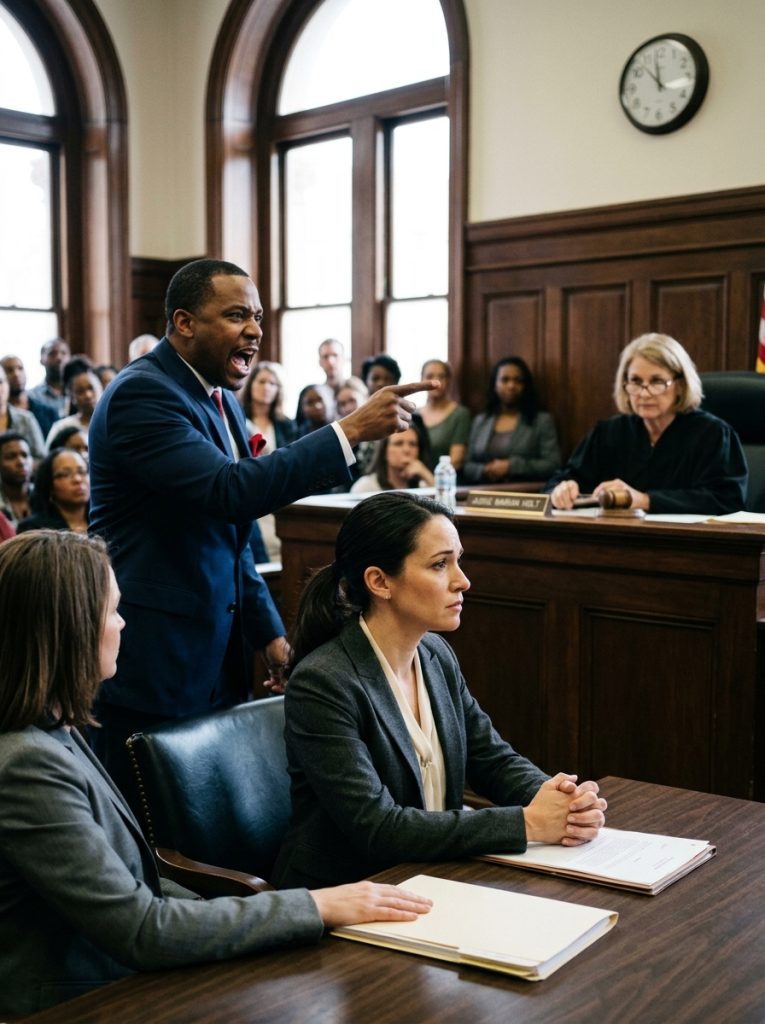
Inside the folder was a single thing: a small audio recorder, and a notarized page clipped to it.
“Your Honor, with the court’s permission,” my attorney said, rising, “the defense submits a statement recorded by the deceased, Harold Calloway, three days before his death, in the presence of his physician and a licensed notary, both of whom are present today and prepared to authenticate it.”
Vincent shot to his feet. “This is theater. She coached a dying man—”
“Sit down, Mr. Calloway,” Judge Holt said.
I pressed play.
And the courtroom filled with my father’s voice.
Thin. Tired. But unmistakably him, the man who taught me to change a tire and never raise my voice when I was right.
“My name is Harold Calloway. I’m of sound mind, and Dr. Patel and Ms. Okafor are sitting right here so nobody can pretend otherwise.”
A pause. A breath that rattled. I gripped the table.
“If you’re hearing this, then Vincent did exactly what I knew he’d do the second I was gone. He’s standing in a courtroom calling his sister a forger.”
Every head in the gallery turned toward Vincent. His face was the color of ash.
“I left the house and the trust to Rachel on purpose,” my father’s voice went on. “Not because I love her more. Because three years ago Vincent took out a second mortgage on this family in my name, forged my signature to do it, and I covered it quietly to keep him out of prison. I have the bank’s letter. It’s in the same folder as this recorder.”
My attorney slid the letter across to the bench.
“Rachel never knew,” the recording said. “She still doesn’t, as I make this. She was the one who sat with me at night. Vincent visited when he needed money. I’m not bitter about it. A father loves the child who needs him. But I will not let the son who already stole from me once finish the job by stealing from her.”
The recorder hissed faintly. Then, softer, the part that undid me:
“Rachel-girl. If you’re playing this, it means it got ugly, and I’m sorry you had to stand up in a room and be called a liar to defend something I gave you out of love. Open the folder. Let my voice do the lifting. You’ve carried enough.”
The recording clicked off.
Nobody moved. The wall clock that had terrified me ten minutes ago kept ticking into total silence.
Judge Holt removed her reading glasses.
“Ms. Pruitt,” she said quietly, “I’ll hear from the notary and the physician.”
They were brief. They were unshakable. Yes, Mr. Calloway recorded the statement freely. Yes, he was lucid. Yes, this is the forgery letter from the bank, dated and verified, predating his death by three years.
Vincent’s lawyer asked for a recess. The judge denied it.
It didn’t take long after that.
The will stood. The house and the trust were mine, free and clear, exactly as my father intended. Judge Holt found that Vincent had brought the fraud claim in bad faith and ordered him to pay every dollar of my legal fees.
Then she did one more thing. She instructed the clerk to refer the forged-mortgage matter — the one my father had buried to save his son — to the district attorney’s office.
Dad had protected Vincent in life. He couldn’t anymore. By trying to bury me, my brother had dug up the very thing our father spent three years hiding to keep him free.
Vincent caught me in the marble hallway afterward. The navy suit, the red pocket square, all of it looked like a costume now.
“You let him record that,” he said. “You ambushed me.”
“He recorded it,” I said. “I just stopped protecting you, the way he finally had to.”
I walked out into the Texas afternoon.
I’d won. I want to be honest that it didn’t feel like winning. I’d had to sit in a public room and listen to my dead father defend me, which meant I had to lose him all over again to keep what he’d left me.
I drove to the cemetery instead of home.
I sat in the grass by the fresh stone and I told him it worked. That his voice did the lifting, just like he promised. That I was okay, and the house was safe, and he didn’t have to worry about either of us anymore.
The recorder was still in my purse. I never erased it.
Some nights, when the house is quiet, I play those last few lines.
You’ve carried enough.
And for a few seconds, my father is in the room again, telling me I can finally set it down.