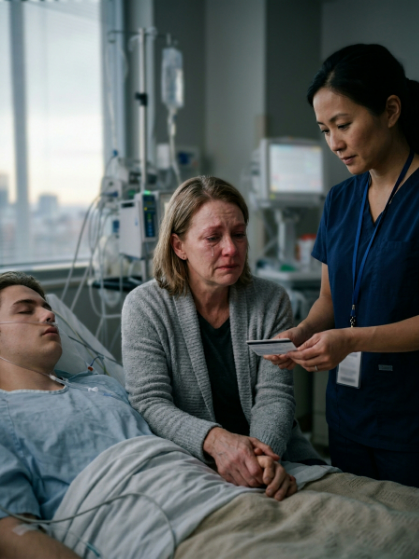
The paperwork was already done. That was the part that undid me.
I didn’t have to decide anything. My boy had decided for himself, eight days before the ice, sitting at a kitchen table I would never see, checking boxes on a form he never mentioned.
All I had to do was not get in the way of who he already was.
So I signed where Renee showed me, and I held his hand until they told me, gently, that it was time.
I won’t write down the part that came next. Some hours belong only to a mother.
I’ll only say that the room was quiet, that the dawn came up gray over Denver, and that the nurses moved like they were handling something sacred. Because they were.
For weeks afterward, the house was unbearable.
I’d find his sneakers by the door. A half-charged phone cable. A grocery list in his handwriting on the fridge — milk, the good cereal, batteries — and I’d stand there and read three words like scripture.
I kept his bedroom door shut. Then I kept it open. Neither one helped.
One night I made myself go through his laptop, looking for I don’t know what. A photo. A voice memo. Something.
What I found was a confirmation email, dated eight days before the crash. A simple receipt from the state registry, thanking him for updating his license. He’d opened it once and never replied. He hadn’t told a soul.
I sat on his bedroom floor and read it eleven times. My quiet boy, making a loud choice in the dark, the way he did everything — without needing anyone to watch.
Then the first letter came.
The donor network forwards them, with names removed, if the families on both sides agree. I almost didn’t open it.
It was from a woman in Pueblo. A teacher. She wrote that she’d spent two years too sick to stand in front of her class. That she was back now. That her students had made her a banner. She didn’t know my son’s name, but she thanked him in every line.
The second was from the father of a seven-year-old girl. He wrote that she’d started kindergarten on time after all. That she’d lost her first tooth last week.
The third came from a man who had waited three years and had nearly stopped hoping.
The fourth came last, and it was the shortest. Four words, in shaky cursive.
Just: I get more time.
Four strangers. Four phones that rang on the worst night of my life and turned it, somehow, into the first morning of the rest of theirs.
It did not bring Tyler back.
I want to be honest about that, because grief lies in both directions, and the cruelest lie is that something good can make a loss even. It can’t. I would trade every one of those letters to hear his key in the lock again. Any mother would. That isn’t ingratitude. That’s just love, doing what love does.
But here is the other true thing. The one I hold on the nights the house is too quiet.
My nineteen-year-old, who never once told me, looked at a form on some ordinary evening and decided that if the worst ever happened, strangers should get to keep their kids, keep their classrooms, keep their time.
He was already the man I’d hoped he would become.
I just didn’t get to watch the rest of it.
In the spring, the teacher from Pueblo asked if we could meet. We sat in a diner halfway between our towns. She was nervous. So was I.
We didn’t talk about medicine. We talked about her students, and about Tyler — what made him laugh, the documentaries he loved, how he texted me “home soon” out of pure habit even at nineteen.
When we hugged goodbye in the parking lot, she held on a beat longer than strangers do.
I’ve started speaking now. Small rooms. A church basement, a community college, a DMV that lets me set up a folding table by the license counter. I tell people it takes two minutes. I tell them their kids might do it without saying a word, the way mine did, and that they should ask while there’s still time to hear the answer.
Last month a teenager came to my table, maybe seventeen, dragging his feet while his mother waited in line. He rolled his eyes at the whole idea. Then he looked at the photo of Tyler I keep propped there, asked how old he was, and went quiet.
He signed before his mother even reached the counter. He didn’t tell her either.
I had to turn away so he wouldn’t see my face.
I keep his last text on my phone. I’ll never delete it.
Love you, Mom. Home soon.
He’s not coming home.
But four families set an extra plate this year, and somewhere out there, my son’s quiet yes is still keeping the lights on.