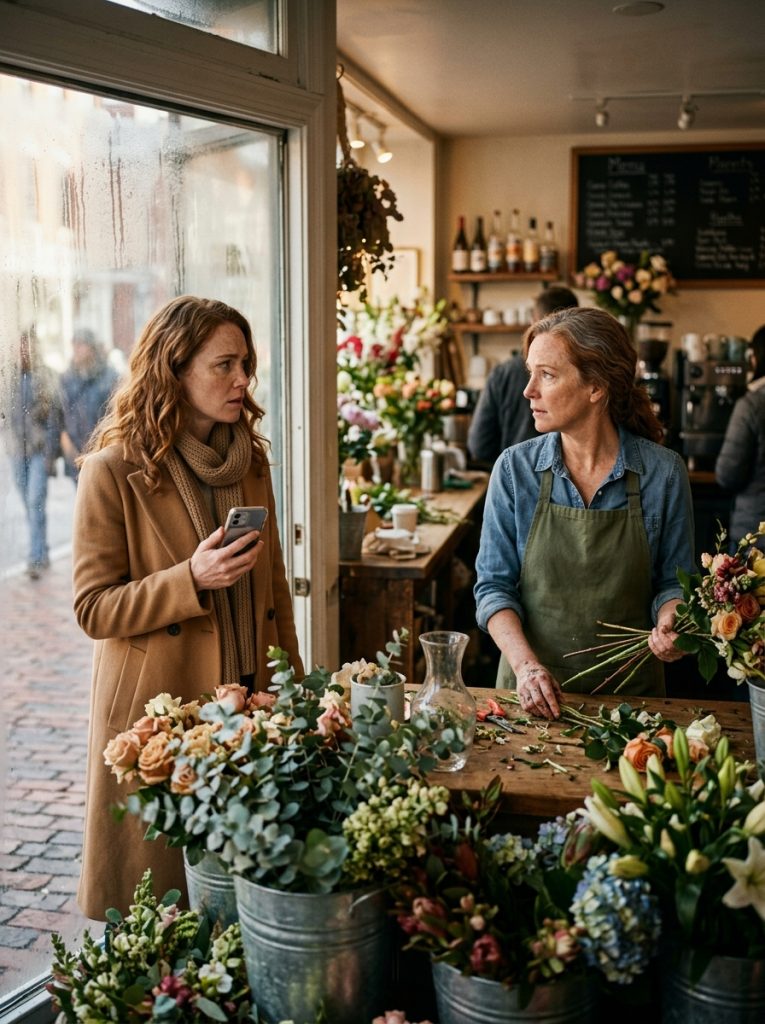
The bell over the door was still ringing when Ruth looked up.
She had a half-finished bouquet in her hands — ranunculus, I’d learn later, her favorite, the ones she always pushed on undecided customers. She looked at me the way she had a hundred mornings before. Friendly. Easy. “Morning, hon, the oat milk’s fresh today—”
And then she stopped.
Because I wasn’t moving. I was standing just inside the door in my camel coat with my phone shaking in my hand, and I was crying, and I hadn’t said a word.
Her eyes went over my face the way you read something you can’t quite believe. My freckles. My eyes. The set of a jaw she’d have seen in a mirror for forty-nine years.
The ranunculus slipped out of her hands onto the counter.
“Oh,” she said. Just that. A small, broken sound. “Oh, no. Oh, sweetheart.”
“I did a DNA test,” I managed. “It said — it said four blocks. It said mother.” I held the phone up like evidence, like proof, like the only sentence I could get out. “Ruth, it’s you. I think it’s you.”
She came around the counter so fast she knocked over a bucket of stems, water everywhere, neither of us caring. She stopped a foot away, hands hovering like she wasn’t allowed to touch me, like I might not be real.
“What’s your birthday,” she whispered.
“March ninth. Nineteen ninety-three.”
A sound came out of her that I will hear for the rest of my life. She pressed both hands to her mouth and folded forward, and I caught her, this woman I’d been buying coffee from for six years, and we stood in the spilled water and the cut flowers and held on like the floor was tilting.
She was sixteen when she had me.
She told me everything that morning, the shop sign flipped to CLOSED, two cold cups of coffee going colder between us.
She was sixteen, and scared, and her parents were the kind of people for whom appearances were a religion. They decided. They drove her three hours to a city where no one knew them. They told her it was best for the baby, best for everyone, that she’d understand someday. They told her she was not to look, not to write, not to wonder out loud. The records were sealed and her mother told her to think of it as a door that locked from both sides.
She did look. That was the part that undid me.
She’d hired a searcher in her twenties and hit the same sealed wall I would hit thirty years later. She’d registered with every reunion registry that existed. She’d written letters to an agency that wrote back the same closed-door form every time.
And then — and she said this part with her hands wrapped around mine — when she was thirty-four and her parents were gone and there was no one left to disappoint, she’d moved to Providence.
“Why Providence?” I asked.
“Because the agency was here,” she said. “The one that handled it. I told myself if I lived in the same city, maybe — I don’t know. Maybe the same streets. Maybe I’d feel it.” She laughed, wet and disbelieving. “People told me that was crazy. Move to a whole city on a feeling.”
She’d opened the flower shop eleven years ago. I’d started coming in six years ago, when I moved into the neighborhood for a job.
We had been four blocks apart for six years. She had sold me coffee, complimented my scarf, slipped eucalyptus into my bag because I “looked like I needed something green.”
“I felt something for you,” she said, almost ashamed of it. “I thought I was just a sentimental old woman who got attached to her regulars. I didn’t let myself — you don’t let yourself think a thing like that. It’s too big.”
I’m not going to tell you it was simple after that. It wasn’t.
There’s grief tangled all through it. Grief for the thirty-three years. Grief for the six we wasted being strangers four blocks apart. My parents — the ones who raised me, who I love with my whole heart — had to make room for this, and that took some tender, careful conversations. Ruth had to learn she was allowed to be in my life without apologizing for existing in it.
But here’s where we are now.
I still get my coffee at Ruth’s. Oat milk. She still won’t let me pay.
On Sundays I help her close, and she teaches me the flowers — which ones last, which ones sulk, how to talk an undecided customer into ranunculus.
Last month she came to dinner at my parents’ house. My mother and Ruth did the dishes together, two women who’d loved the same daughter across thirty years, and I stood in the doorway and watched and could not speak.
People ask how I feel about all that lost time. All those mornings we stood three feet apart and didn’t know.
I used to think it was the cruelest part.
Now I think about it differently.
For six years, before either of us knew a thing, my mother kept finding small reasons to put something alive in my hands and send me back out into the world.
She was loving me the whole time.
We just didn’t have the word for it yet.