My hands were shaking so badly I almost couldn’t lift it down.
The green paint can was Harold’s. Of course it was. He’d painted the porch rail that color the summer before he passed and complained the whole time that the woman at the hardware store had talked him into “sage” when he’d asked for “green.”
Behind it, pushed all the way to the back of the third shelf, was a gray metal box.
A fireproof box, the kind they sell for documents. Heavier than it looked. There was a strip of masking tape across the top, and on the tape, in Harold’s blocky handwriting, two words.
For Rainey.
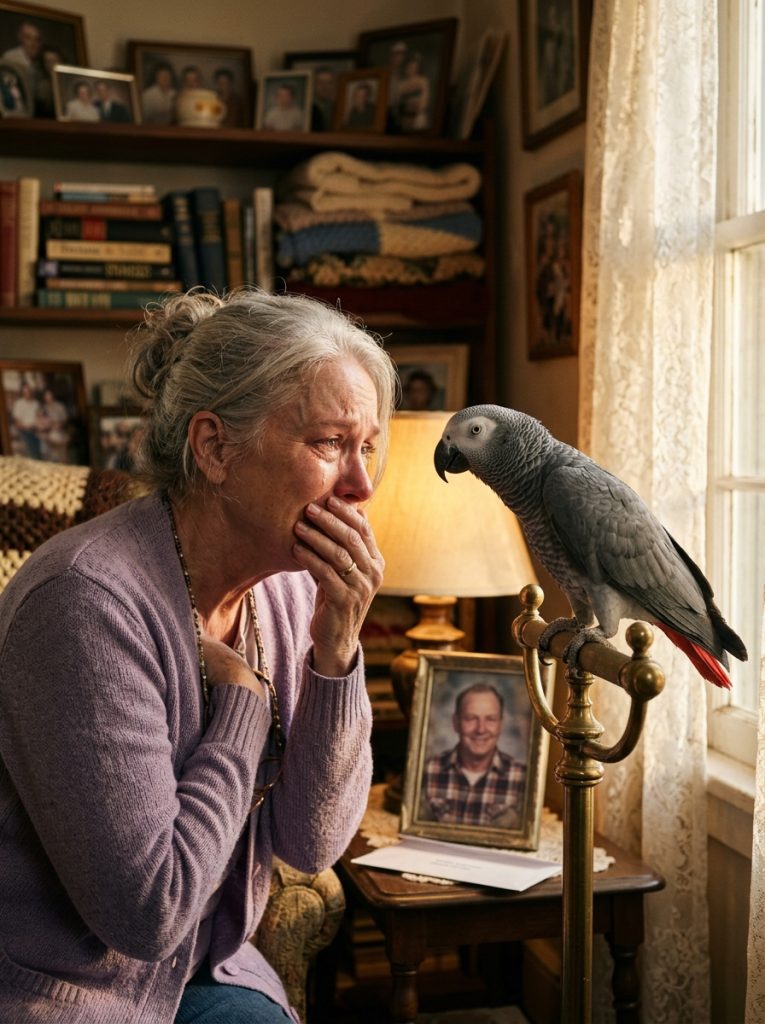
I had to sit down on his old work stool and just breathe for a minute. Captain, who I’d carried out to the workshop on my shoulder because I couldn’t bear to leave him in the house, sidestepped down my arm and said it one more time, soft.
“Third shelf. Behind the green. Rainey.”
“I know, sweetheart,” I told him. “I’m here. I found it.”
The key was taped underneath, because that was Harold all over — careful, and certain I’d be too rattled to think of looking.
Inside the box was our whole life, sorted the way he sorted everything.
The deed to the house, free and clear. The title to the truck. Our marriage certificate, soft at the folds.
And an envelope of United States savings bonds. Dozens of them. Series EE, bought a few at a time over what must have been forty years, every birthday and anniversary and good harvest he never told me about. I sat there and added up the maturity values with a pencil from his bench and a hand that wouldn’t hold still, and the number was more than the back taxes.
It was so much more than the back taxes.
That man. That quiet, flannel-shirted, sage-not-green man had been tucking away a safety net for me in the dark for four decades, and never said a word, because saying it would have meant admitting out loud that one day he’d be gone and I’d be the one left.
There was a letter too. One page, both sides, in pen.
I won’t give you all of it. Some of it belongs only to me. But I’ll give you the part that matters.
He wrote that he’d started teaching Captain the phrase the winter the doctor first used the word “heart” in a way Harold didn’t like. He wrote that he knew me — knew I’d be too proud to go through his workshop, too sad, that I’d let the bank scare me before I ever thought to look. So he didn’t leave the message in a drawer I’d find too soon and cry over for years. He left it with the one voice in the house that would keep saying it, patient and stubborn, until I finally listened.
“You always said that bird only ever repeated nonsense,” he wrote. “I needed you to hear the one thing that wasn’t. I’m sorry I couldn’t tell you to your face, Rainey. I never could say the big things looking at you. You know that. So I taught them to the bird, and I trusted you to follow my voice one more time. Third shelf. Behind the green. I’ll be there, in a way. Pay the county, keep the house, and don’t you dare sell my workshop. Plant the tomatoes. I love you more than I ever found the words for. — H”
I sat in that cold workshop and cried until Captain got worried and started saying “good morning, beautiful” in Harold’s voice, which only made it worse, and then somehow better.
I paid the county the following Tuesday.
The clerk slid the receipt across and said, “Well, that’s that, Mrs. Webb. House is all yours, no liens, no nothing.” She had no idea she was handing me the end of a forty-year secret.
My nephew Greg called that night, already gearing up his speech about assisted living and “being realistic.”
I told him the house was paid, the taxes were settled, and I’d thank him not to measure my windows for a sale that was never going to happen.
He was quiet a second. Then he said, “Aunt Rainey, how?”
And I looked over at the brass perch by the window, where a gray parrot with a red tail was preening in the last of the afternoon light.
“My husband told me where to look,” I said. “I just took my time learning how to listen.”
They still call me the crazy widow who talks to a bird.
Let them.
They don’t know that the bird is the only one in this town who ever told me the truth about how loved I was.
Every morning now I uncover his cage, and Captain tilts his head, and he says, “Good morning, beautiful,” in the voice of a man who planned, down to the last detail, how to keep taking care of me after he was gone.
And every morning I say it back.