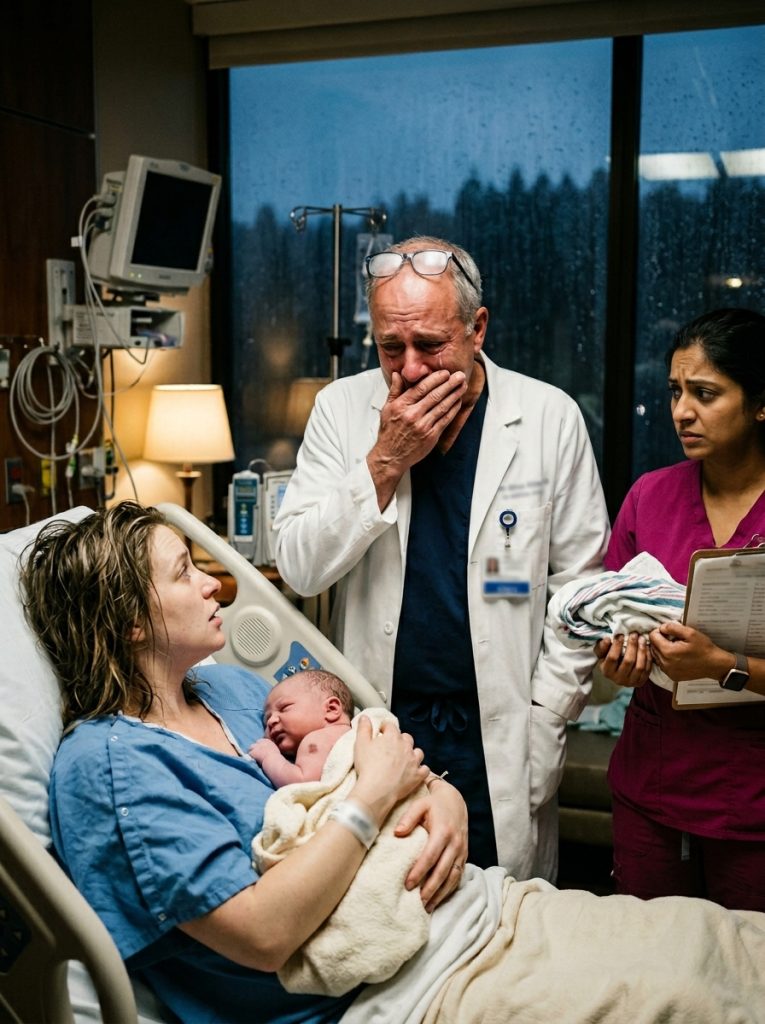
He didn’t answer my question. Not at first.
He set my chart down very carefully, like it might break, and he wiped his face with the back of his hand the way men his age do when they’re not used to being seen crying.
“Daniel,” he said. “You wrote Daniel Whitman.”
“His name’s on her birth record,” I said. My arms tightened around my daughter. “Why does that matter to you?”
And Dr. Aldous Whitman looked at me, and he said the sentence that turned the whole night inside out.
“Because Daniel Whitman is my son. And I haven’t heard his voice in six years.”
The room didn’t make sense for a moment. Priya stood frozen with the swaddle blanket. The rain kept coming.
I had a thousand questions and only the strength for one. “He’s your son?”
“He stopped speaking to me when he was twenty-six,” he said quietly. “He thinks I chose my career over his mother when she was sick. He thinks I wasn’t there.” A long breath. “He was right about the second part. He was wrong about why.”
Here is what I knew about Daniel: that he was charming and then he was cold. That he loved me until I told him I was pregnant, and then one morning he packed a bag and said he wasn’t built for this and walked out at seven months.
Here is what I did not know: that he had a father.
He’d told me both his parents were gone.
“He told me you were dead,” I said.
The old man flinched like I’d struck him. “Of course he did,” he murmured. “That’s how he grieves. He buries people before they can leave him.” He looked at the baby. “He learned that from watching me bury myself in work while his mother was dying. I told myself I was earning the money for her treatment. I told myself there’d be time after. There wasn’t. And my boy has never forgiven me for the math.”
The misunderstanding had a shape now, and the shape was a family that loved each other in all the wrong tenses.
“I wasn’t absent because I didn’t love her,” he said. “I was a young surgeon who believed if I just worked hard enough I could out-earn death. By the time I understood that I couldn’t, Daniel had already decided who I was. And nothing I’ve said in six years has been able to move it.”
He reached out — slowly, asking with his eyes — and touched the edge of the blanket. My daughter gripped his finger the way babies do.
That was when his composure left him entirely.
“She has his hands,” he whispered. “She has his exact hands.”
I should have been angry. Part of me was. This man’s absence and his son’s absence were the same wound running through two generations, and I was the one left holding the result of it in a hospital gown.
But I watched a grandfather meet his granddaughter, and I could not find it in me to make that moment smaller than it was.
We talked until the sky started to gray. He told me about Daniel at six, at sixteen, the good years before the loss. I told him the truth I’d been swallowing for months — that Daniel wasn’t a villain, just a frightened man who ran from anything that could hurt him by mattering.
“Then we have that in common,” Aldous said. “Running.”
He pulled out his phone. Six years of unanswered messages, he showed me. The last one from his son simply said: stop. He scrolled to a contact and his thumb hovered.
“If I call him and tell him he has a daughter,” he said, “he may run from both of us at once.”
“Or,” I said, “he might hear it from the one person he can’t accuse of choosing work over family. His father. Calling about a baby. At dawn.”
He looked at me for a long time.
Then he stepped into the hall, and through the glass I watched him put the phone to his ear.
I don’t know everything that was said. I saw the old man’s shoulders shake. I saw him press his free hand flat against the glass like he needed it to stand. I saw him say a name — Danny — the small version, the boy version — and then I saw him go quiet and just listen, nodding, tears running freely now, for a very long time.
When he came back in, he couldn’t speak. He just nodded at me, over and over, and the nodding said enough.
Daniel didn’t fix everything that morning. People don’t. He didn’t come running to the hospital and become a father in a single scene. That’s not how real men who are afraid actually change.
But he answered.
He stayed on the line.
And he asked his father one question, the first real question he’d asked him in six years: “Is she okay? Are they both okay?”
That was the wall coming down. One brick. From the top.
My daughter is three weeks old now. Her grandfather comes by every few days — off the clock, just Aldous, with terrible coffee and a soft toy and a face that lights up like a window when he holds her.
Daniel calls his father now. They are slow about it. Careful. Two men learning a language they let go to rust.
He has called me twice. We are not a fairy tale, he and I. I don’t know what we’ll be.
But the night I gave birth alone turned out not to be alone at all.
It was the night a family that had been burying each other for years finally, finally started digging the other way.