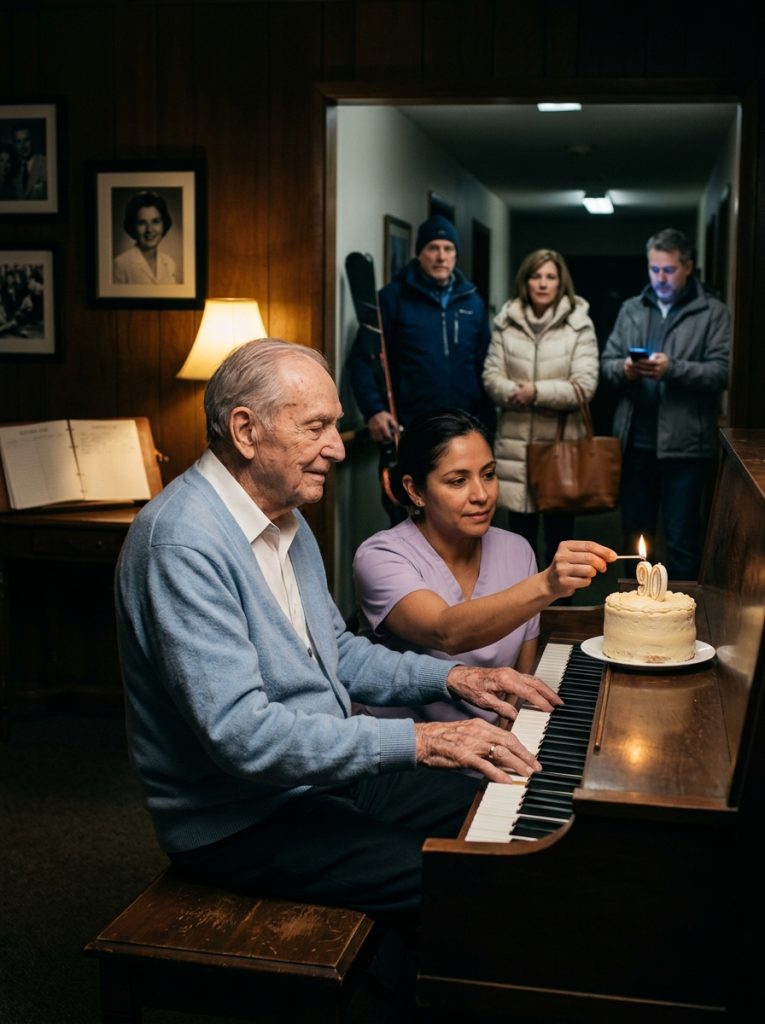
Edward Park set his black folder on the table beside the visitor log, and the common room of Cedarbrook went quiet except for Bill Evans turning slow circles on the record player.
“Before anyone signs anything,” he said again, “I’d like to read from the log. Mr. Henderson asked me to, if his children ever came.”
Linda’s gloved hand froze halfway to her purse.
Edward opened the leather book. “Visits to Walter Henderson over the past twenty-four months,” he read. “From Robert Henderson: none. From Linda Henderson-Cole: none. From Stephen Henderson: none.” He turned a page. “From Margaret Reyes, staff: six hundred and eighteen.”
I felt my face go hot. I hadn’t known he’d counted. I certainly hadn’t known anyone else had.
“Six hundred and eighteen,” Edward repeated. “Birthdays. Holidays. The afternoon he had pneumonia and they kept him on oxygen. The morning he forgot where he was and she sat with him until he came back. None of those days appear under your names.” He closed the log. “I mention it only because the document you came to have signed tonight — the release for the safe-deposit box — assumes a relationship the log does not reflect.”
“That’s our father,” Robert said, bristling. “We’ve been busy. We have lives, families—”
“You have a flight,” Edward said mildly, glancing at the ski bags by the door. “I understand. I won’t keep you long.”
He took a single bound document out of the folder.
“Three weeks ago, Mr. Henderson asked me to draft a new will. He executed it here, in this room, with two members of the Cedarbrook staff as witnesses — not Ms. Reyes, before anyone suggests it; she wasn’t even told. He was examined that morning by his physician and found entirely of sound mind.” He set the document down. “I’ll summarize, and you’re welcome to read every word.
“The family home — the one I believe the safe-deposit paperwork concerns — is not being divided. Mr. Henderson has placed it, and the bulk of his estate, into a fund. A scholarship for nursing students, administered in the name of his late wife, Eleanor Henderson, who was a nurse for thirty-one years.”
Stephen finally looked up from his phone.
“The executor of the estate,” Edward continued, “is Margaret Reyes.”
“Her?” Linda’s voice cracked. “She’s a — she’s an aide. She’s a stranger.”
I opened my mouth, but Walt got there first.
He’d been quiet this whole time, sitting at the piano bench in his soft blue cardigan, hands resting on the keys. Now he turned around on the bench, slowly, and looked at his three children with eyes that were tired but absolutely clear.
“She’s not a stranger,” Walt said. “She’s the person who showed up. That’s the whole definition, as far as I can tell. You show up, you’re family. You don’t, you’re a name in a book.” He nodded at the log. “It’s a very honest book.”
“Dad—” Robert started.
“Each of you receives one dollar,” Edward said, “and a sealed letter, which Mr. Henderson wrote himself. He asked that you not open them here.” He laid three envelopes on the table, three crisp dollar bills paper-clipped to them. “That concludes the matter. There’s nothing to sign tonight. There never was.”
I have replayed the next part many times.
They didn’t shout, not really. Linda said something sharp about contesting it. Edward said, very calmly, that the documentation was thorough and the witnesses credible and that she was of course free to try. Robert picked up his envelope, looked at the dollar bill, and his jaw worked like he wanted to say something that wouldn’t come. Stephen just put his envelope in his coat pocket without a word.
Then they left. Coats, ski bags, the cold rush of the parking lot door, and gone. Off to the mountains. The whole thing took less than fifteen minutes, start to finish, after two years of nothing.
The record had reached the quiet part. The other residents had drifted back to their rooms. It was just Walt and me and a small vanilla cake with one candle still burning.
“You counted,” I said. “Six hundred and eighteen.”
“You counted first,” he said. “You just didn’t write it down.” He smiled, that small tired sunrise of a smile. “Are we going to let that candle go to waste, or are we going to eat cake?”
We ate cake off paper plates at the piano. He told me about Eleanor, how she could quiet a whole pediatric ward with one song, how he’d written the scholarship for her because the world should have more of her in it and less of whatever his children had become. He played a little Bill Evans, badly, because his hands weren’t what they were, and it was the most beautiful thing I’d heard in years.
At nine I helped him back to his room. He was happy. I want that on the record more than anything: on the night of his ninetieth birthday, Walter Henderson was happy, and known, and not alone.
He didn’t wake up the next morning.
The night nurse found him peaceful, hands folded, the way you’d hope. The doctor said his heart simply stopped — no pain, no struggle. Ninety years, and he chose his last clear evening to set everything right.
I administer the Eleanor Henderson Nursing Scholarship now. We funded our first four students this fall. Each of them gets a letter when they’re selected, and the letter ends with a line Walt gave me, three weeks before he died, when he was signing the papers and I asked him what he wanted the students to know.
“Tell them,” he said, “that someone is always keeping a log. So be the kind of person worth writing down.”
His three children never opened their envelopes, as far as I know. I opened the copy he left for me.
It said: Thank you for the six hundred and eighteen. You can stop counting now.
I haven’t, though.
I still count the people who show up.